Nature Already Packaged Avocado Oil
The craze, the carbon, and what gets lost when an ancestral food becomes an industrial ingredient
There is a grocery-store shelf where oil has started to look like wellness: green labels, matte bottles, words such as pure, cold-pressed, and extra virgin.
Avocado oil is not being sold only as cooking fat. It is being sold as relief—from the seed-oil argument, ultra-processed guilt, and the work of reading another ingredient list.
One bottle. One better choice. Done.
Pero, better at what—health, cooking, sustainability, or profit?
Those are different questions. The craze sells them as one answer. Ahí está el truco.
Why avocado oil is suddenly everywhere
Avocado oil is now in chips, mayonesa, dressings, sprays, and plant-based meats. This is not only a trend; it is a premium ingredient market. Beyond Meat reformulated products around it, while Fresh Del Monte invested in avocado-oil production and fruit rejected by the fresh market. (Beyond Meat, 2024; Fresh Del Monte, 2025)
The label says “better oil.” The food system still has to show its work.
Before the oil, there was el aguacate
El aguacate did not begin as wellness branding. People in Central America cultivated and selected avocados for thousands of years. That is agricultural authorship—knowledge built through place, seed, season, and generations. (University of California, 2025)
The ancestral fruit was never just fat. It was fiber, water, sabor, el hueso, seed stock, and a relationship between people and land.
Today, roughly 90 percent of the global industry relies on Hass. We inherited deep biological and cultural diversity, commercialized one version, and concentrated it into oil.
How many avocados are in a bottle?
There is no independently verified universal count. Yield changes with variety, size, ripeness, oil content, and extraction.
One producer estimates that a 500-milliliter bottle may require 15 to 22 avocados—roughly 30 to 44 per liter. Treat that as a producer estimate, not a law of nature. (Chosen Foods)
The larger point holds:
A liter of avocado oil is not one avocado made convenient. It is dozens of fruits agriculturally concentrated.
Fiber, water, carbohydrate, and physical structure are separated. What remains is useful, but it is not the same food.
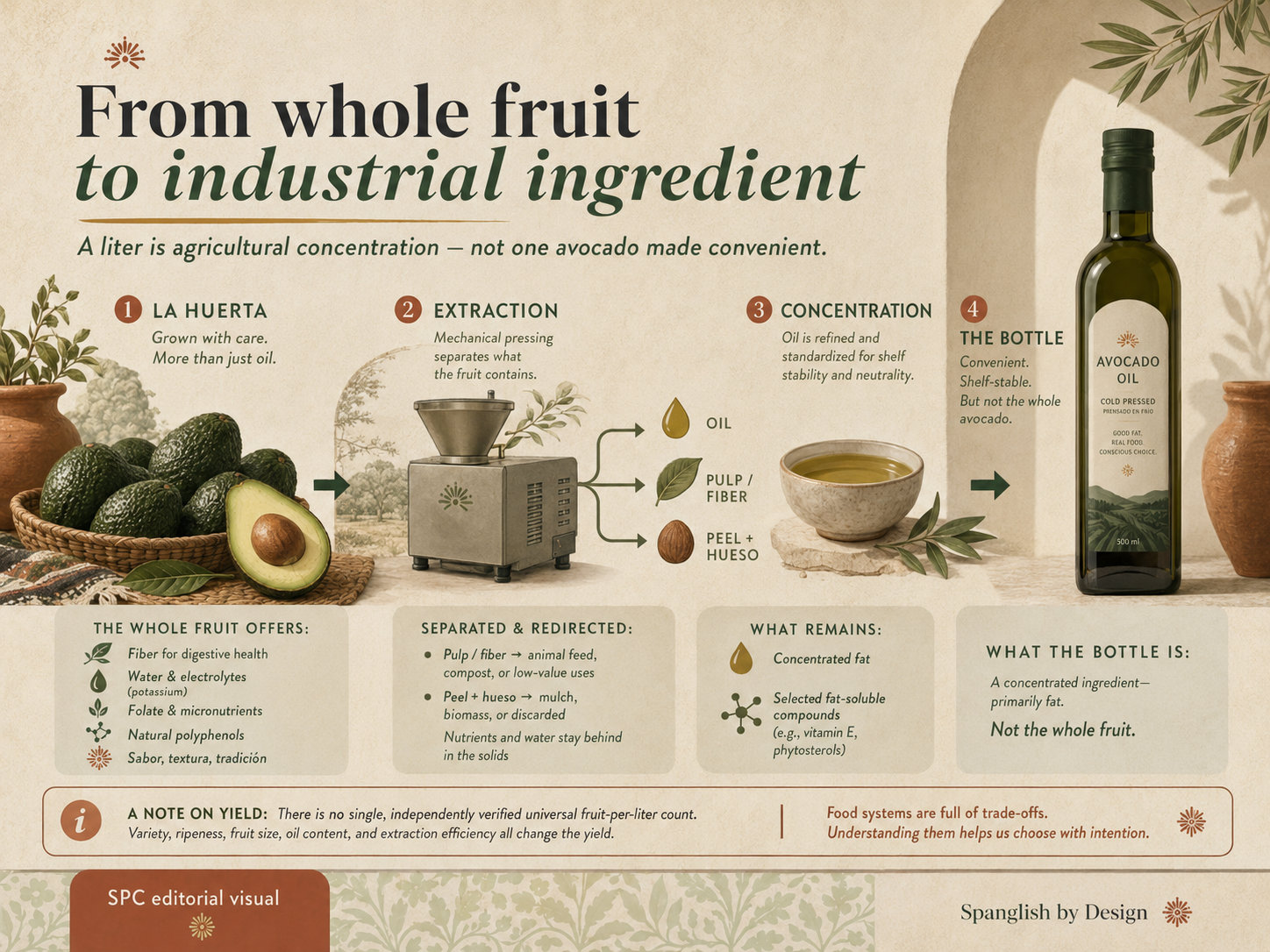
La huerta, extraction, concentration, and the bottle. Original SPC editorial visual.
Why one footprint number can mislead
A 2026 FAO review found avocado carbon estimates ranging from about 0.29 to 3.75 kilograms of CO₂ equivalent per kilogram of fruit, from farm to export gate. (FAO, 2026)
That twelvefold range is the finding.
“Avocado” alone tells you little about impact without origin, irrigation, fertilizer, transport, processing energy, and the study boundary.
Water works the same way. A global average may combine rain falling on an orchard with groundwater pumped from a stressed basin.
Agua no es agua.
The better question is: Where did the water come from, who else depended on it, and what value did the orchard return?
Avocado expansion in parts of Michoacán has been associated with forest loss and water pressure. That does not make every Mexican avocado responsible for deforestation. It means “plant-based” is not proof of low impact. Trazabilidad matters. (Environmental Research Letters, 2022)
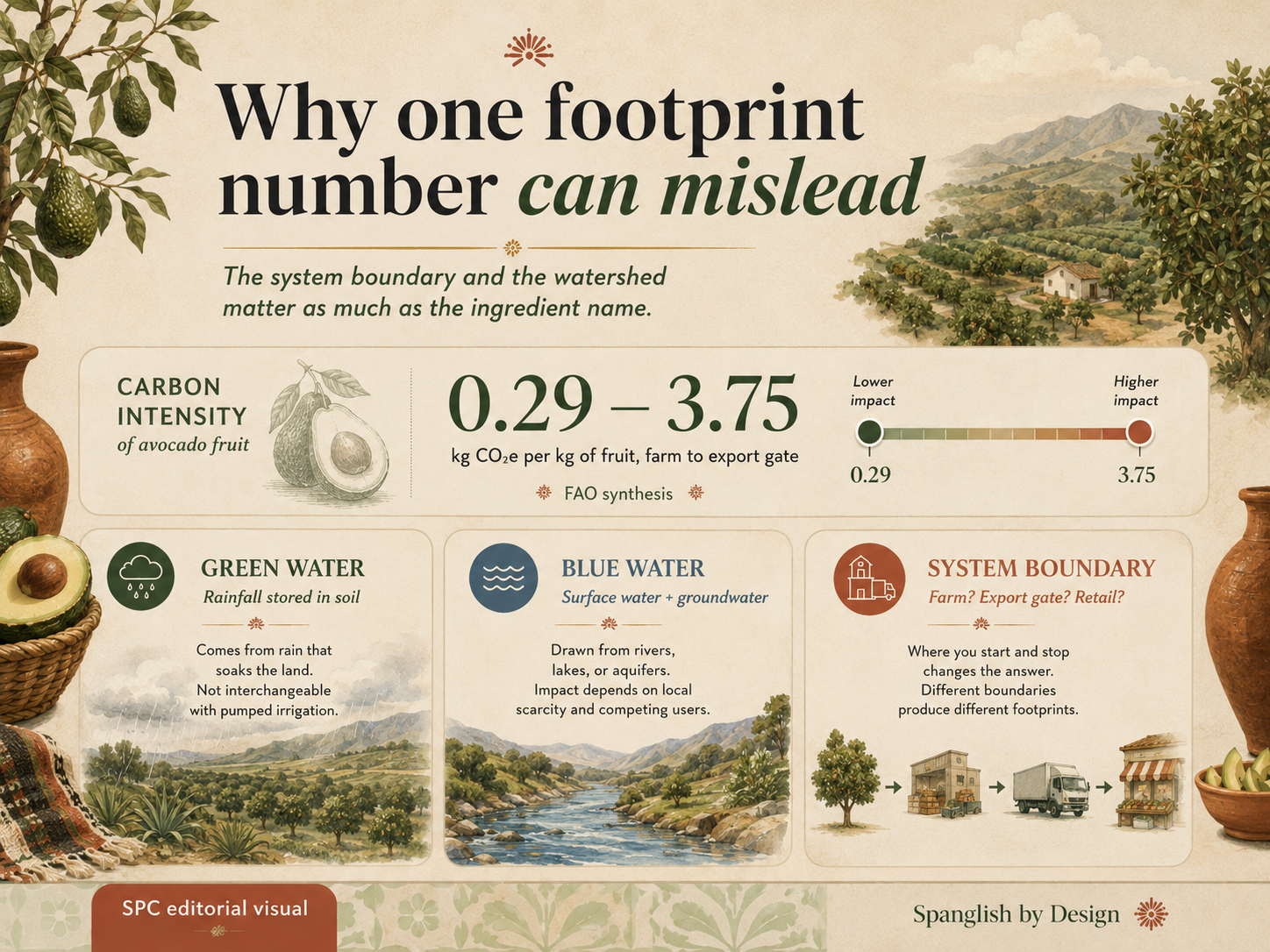
Place, watershed, and system boundaries change the answer. Original SPC editorial visual
The strongest sustainability case: fruta de descarte
Avocado oil can create value from fruit rejected for size, shape, or cosmetic damage. That can reduce loss and create income.
That is real circularity—when it is real.
It follows the resourceful logic behind “A Lo Pobre Was Never Poor”: using what is available is not deprivation. It is knowledge.
But making oil from a waste stream is different from growing more fruit to feed an oil stream. Ask what happened to the peel, el hueso, pulp, and wastewater. Ask whether growers received any of the premium.
The bottle may look identical. The story is not.
Healthy? Yes. A whole avocado? No.
Avocado oil is rich in monounsaturated fat, low in saturated fat, neutral in flavor, and useful for high-heat cooking. Those are real advantages. (American Heart Association)
But oil is not an avocado with the inconvenience removed.
The whole fruit brings fiber, water, potassium, folate, volume, and satiety. The bottle brings concentrated fat and some fat-soluble compounds.
Swapping canola oil for avocado oil in chips does not make them a whole food. Sometimes the recipe improved. Sometimes only the halo did.
Then comes trust. UC Davis studies found oxidation, mislabeling, and adulteration among tested bottled oils. In 2026, researchers reported that 48 of 54 sampled chips, mayonnaises, and dressings marketed with avocado oil contained other oils. (UC Davis, 2020; 2023; 2026)
That does not describe every product. It does justify asking whether the premium label matches what is inside.
Money · Waste · Sabor
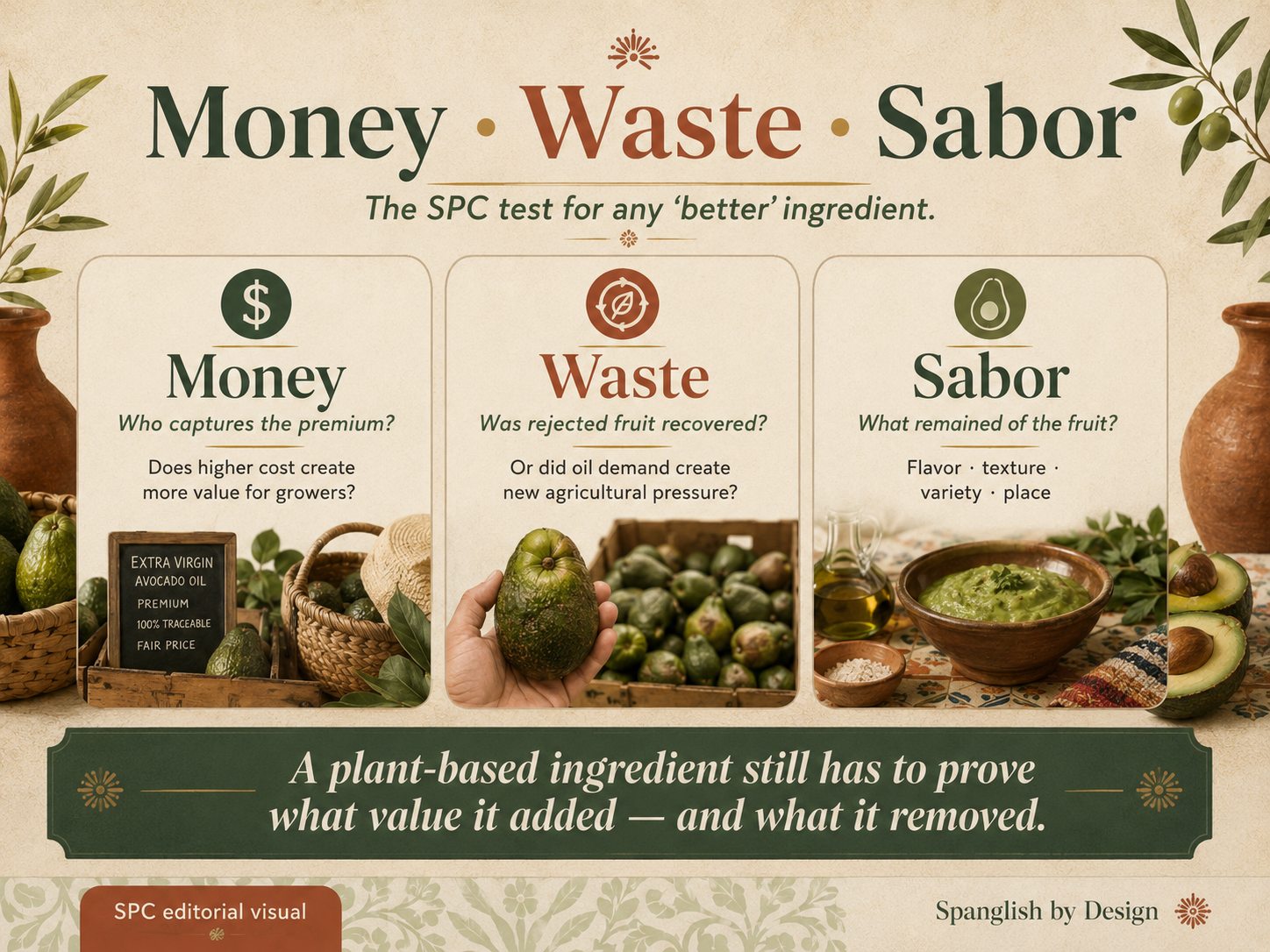
The SPC test for any “better” ingredient. Original SPC editorial visual.
Money: Who captures the premium—the grower, processor, brand, or retailer?
Waste: Was fruta de descarte recovered, or did oil demand create new agricultural pressure?
Sabor: What remained—flavor, texture, variety, and place—or only a marketable name?
This is the SPC test for any “better” ingredient. It is also the flattening examined in “When Heritage Flavor Gets Filtered for the Algorithm”: the name can survive while the context disappears.
So, should you eat an avocado instead?
If you want the nutrition of avocado, eat the avocado.
If you need a neutral oil for roasting, searing, or an emulsion, avocado oil can have a legitimate place.
Those are different decisions.
Choose clear origin, virgin or refined labeling, extraction information, and credible quality verification. Buy a smaller bottle if you use it slowly. Store it away from heat and light. If it smells rancio, do not use it.
Avocado oil does not need to be canceled. It needs to be understood.
No oil becomes healthy because it came from a fruit. No product becomes sustainable because the label is green. And no ancestral food remains culturally intact simply because industry kept its name.
Nature already packaged avocado oil.
It came with fiber, water, sabor, y su cáscara.
The bottle still has to prove what it added—and what it asked the food system to remove.
