Dennis Arvizu · The Work
Proof of work, not just a description of it.
Four samples spanning bilingual AI content, governed automation, data systems, and bilingual editorial design — the same disciplines behind the Fiverr gig and the enterprise track record on the main bio page.
See also: Dennis's full story · Fiverr: AI Spanish translation, human & natural
Client-facing service
Making AI-translated Spanish sound human
FactActive Fiverr service — "I will make your AI Spanish translation sound human and natural." Meaning-parity editing for LATAM and U.S. Hispanic registers, not literal proofreading.
- Repairs robotic AI phrasing, meaning drift, tone mismatch, and regional nuance loss.
- Tiers from a 2-day / 1,000-word Quick Polish up to full delivery with cross-document terminology control.
- Applied sample below: a heritage-speaker Spanish storytelling worksheet (Preterite vs. Imperfect), the same kind of material used in the gig gallery.
Try it — live worksheet excerpt
Ayer, yo una audición para un pódcast de narración de historias.
las tres de la tarde y mucho.
For employers: this is the same discipline used in enterprise localization and internal bilingual communication — content that has to be correct and sound like a real person wrote it.
Automation / AI-ops
A governed, evidence-labeled site audit system
FactBuilt a public-evidence-only Squarespace audit pipeline for spanglishculture.com: scripted crawl → SEO/schema extraction → link check → content/performance/accessibility analysis → compiled executive report, closed with an independent QA pass.
Try it — click a row to toggle it reviewed
| Action item | Priority | Evidence | Status |
|---|---|---|---|
| Rebuild homepage hierarchy around 3 clear paths | P0 | FACT + INTERPRETATION | Open |
| Add proof, FAQ, and schema to every product page | P0 | INTERPRETATION | Open |
| Install event taxonomy before redesign decisions | P0 | NOT PROVIDED | Open |
| Run Lighthouse mobile/desktop (browser lab data) | P1 | ACCESS LIMITATION | Gap |
| Supply GA4 / Search Console exports | P1 | NOT PROVIDED | Gap |
| Add internal-link rule: 1 email CTA per article | P1 | INTERPRETATION | Open |
| Route consulting/B2B positioning off SPC | P2 | INTERPRETATION | N/A |
Reviewed: 0 / 7
- Every finding tagged FACT / INTERPRETATION / NOT PROVIDED / ACCESS LIMITATION — no invented analytics or performance numbers.
- Closed with a FIIA-style governance scan (evidence integrity, reversibility, approval boundary, no-AI counterfactual) before anything was marked usable.
For employers/clients: AI accelerates the audit; a governance layer keeps every claim honest, and nothing ships without explicit approval.
Structured operating knowledge
Data & spreadsheet systems
FactBuilt structured trackers and evidence ledgers supporting content and product operations — including a product tracker, a claim/limitation ledger, and a YouTube/podcast optimization matrix with metadata and claim-risk columns.
Try it — live yield & cost calculator (same logic used in kitchen-costing dashboards)
Direct-ingredient cost only — labor, packaging, utilities, and waste handling are separate cost pools, flagged INSUFFICIENT EVIDENCE until entered. Same True Cost Accounting discipline used for enterprise vendor/waste redesigns.
Enterprise figures are drawn from the published bio on spanglishculture.com; sample spreadsheet structures are available on request under NDA where they contain client or internal data.
Money · Waste · Sabor
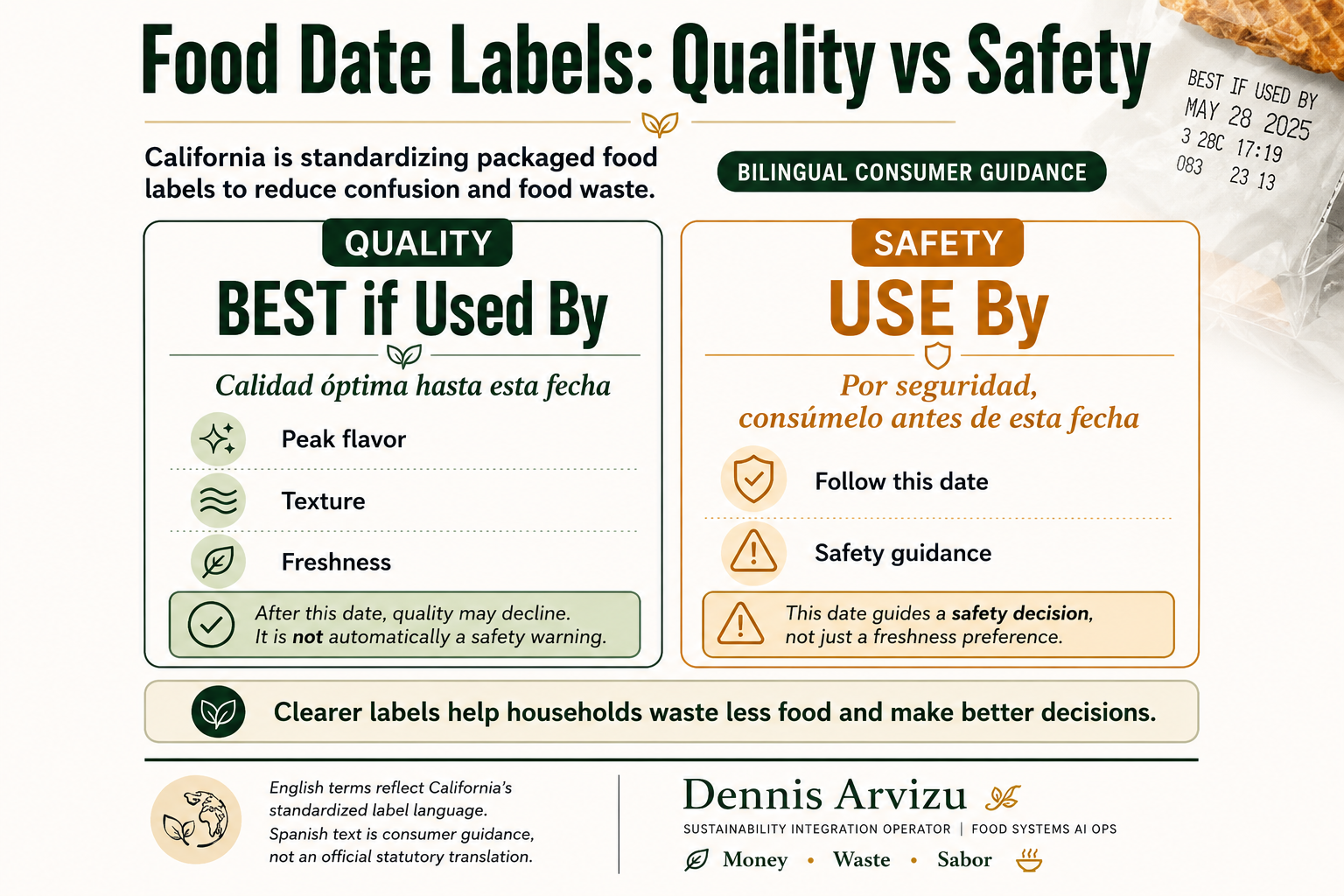
Bilingual infographic — Food Date Labels: Quality vs Safety
FactDesigned a bilingual consumer-education infographic translating California's standardized food-date-label terms (Best if Used By / Use By) into consumer-register Spanish guidance.
- English terms mirror California's statutory label language; Spanish text is explicitly framed as consumer guidance, not an official legal translation — evidence-labeling discipline applied to design, not just prose.
- Distinguishes quality signal from safety signal so households waste less food from misread dates.
- Primary source: California AB 660 (Irwin), effective July 1, 2026 — bans "sell by" labels and mandates "Best If Used By" (quality) and "Use By" (safety) as the only permitted consumer-facing date terms. CDFA source.
Applied carbon accounting — real utility data
True Cost Accounting on a PG&E smart meter
FactTracked 15-minute-interval PG&E smart meter data across a 3-month cooking window comparing radiant vs. induction cooktop, then extended the same True Cost Accounting discipline used in food systems to an always-on home WiFi setup — GHG Protocol Scope 2, EPA eGRID CAMX emission factors, full sourcing and confidence levels disclosed.
Try it — live home-energy carbon & cost calculator
Defaults preloaded from the real WiFi hardware case (Netgear modem + 4 mesh points, ~29W combined). Emission factor default is EPA eGRID 2022 CAMX (California/Mexico subgrid). Try wattage 1500 for an electric stove-top hour, or your own device spec.
Parece apagado porque no hace ruido, pero sigue gastando — it looks off because it makes no noise, but it’s still spending. The core insight of this case study, in the language it first landed in.
- Full data quality statement published with the article: source, method, GHG scope, and a confidence score for every figure (85% stove data, 65% WiFi spec-sheet estimate pending watt-meter verification).
- Backed by 40,000+ rows of real 15-minute-interval PG&E AMI export data — not modeled or assumed consumption.
- Same evidence-labeling discipline as the rest of this page: FACT / INTERPRETATION / WORKING ASSUMPTION / LIMITATION applied to every claim, including the ones that don't flatter the result.
For employers/clients: this is the pattern scaled down to one household — measurement boundary, correct emissions scope, cost vs. carbon vs. percentage kept separate, and a recommendation that's honest about what the data can't yet prove.