Spanglish for Specific Purposes
No se trata de mezclar idiomas porque sí. Se trata de movilizar meaning—where, when, and how people actually need it.
Una tortilla does not become global by losing its identity.
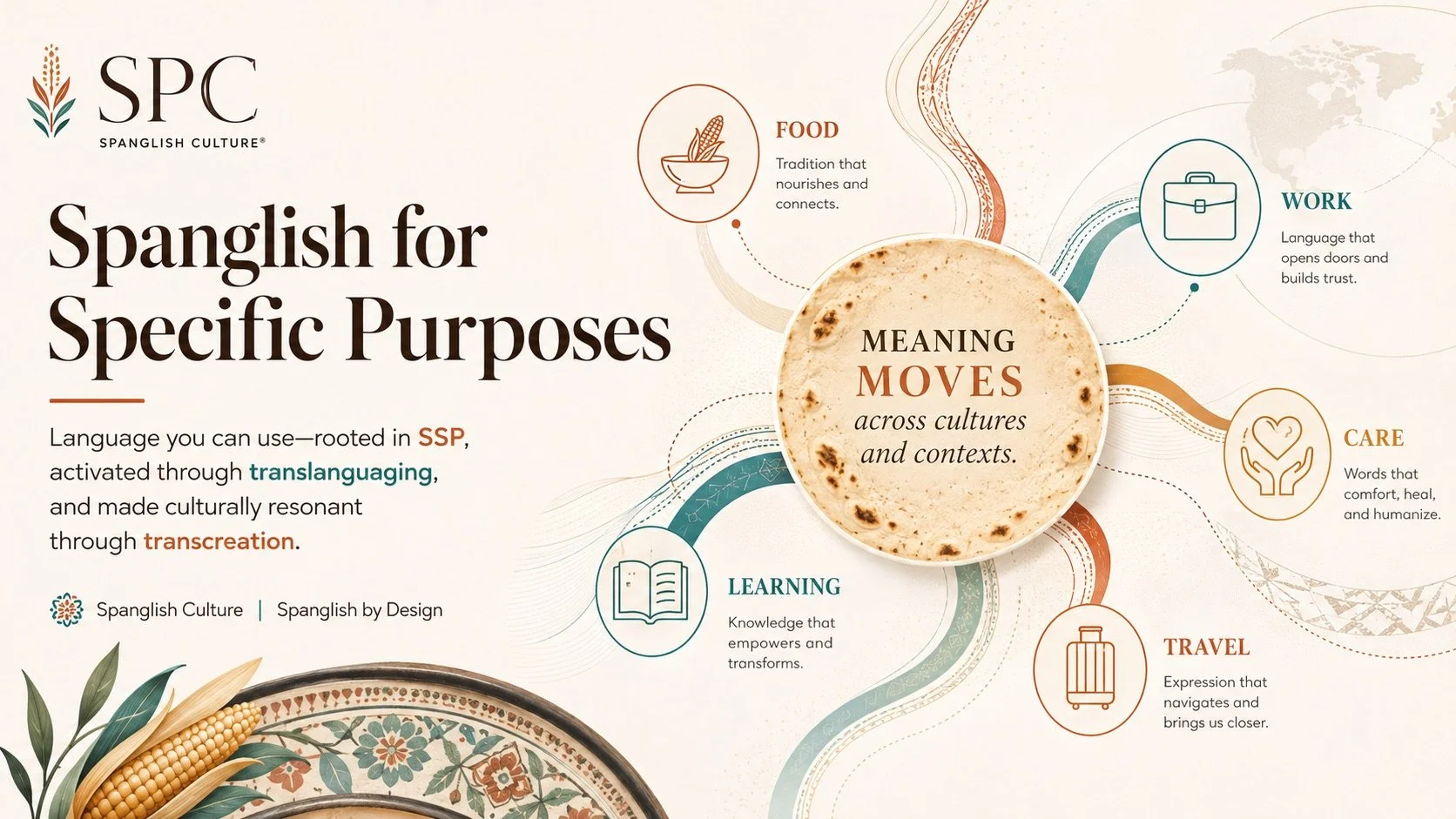
It travels because people learn how to make meaning around it: el maíz, or corn; masa, or dough; comal, or griddle. “Flip it when it puffs.” “Dale la vuelta cuando se infle.” The words shift.
¿Qué no?
The technique is demonstrated through hands, sound, heat, smell, memoria—and sometimes tres lenguajes at the same table.
That is not broken communication. Eso es el lenguaje doing its job.
Language education often starts with what learners should know: o sea, grammar rules, vocabulary lists, conjugation charts, and standardized “correctness.” Spanish for Specific Purposes (SSP) starts somewhere more useful:
What does this person need to do, with whom, in what setting, and what happens if the communication fails?
Spanglish for Specific Purposesadds a second question:
What if the learner’s real communicative repertoire is already bilingual, bicultural, embodied, and shaped by the social world they move through?
Spanglish Culture (SPC) proposes Spanglish for Specific Purposes (SFSP) as a practical design framework: purpose-driven communication that uses a speaker’s available linguistic, cultural, sensory, and professional resources to complete real tasks and build connection. SFSP is rooted in Spanish for Specific Purposes, informed by translanguaging, and—when literal translation is not enough—by transcreation.
SFSP does not claim to replace EFE, translanguaging, or transcreation. Its proposed contribution is operational: define the task and stakes, map the learner’s repertoire and power position, read the setting, then select and assess the language resources that make the communication work.
SFSP is my proposed design framework, not yet a validated curriculum model. Its value should be tested through task completion, repair, register choice, learner agency, safety, and transfer across settings.
It is rooted in EFE/SSP. Informed by translanguaging. When literal translation is not enough, it may draw on transcreation.
“For me, English often carries the technical terms, y español carries el sentir—because feelings need a language that lets the vowels breathe.”
—Dennis Arvizu
What Español para Fines Específicos teaches us
Español para Fines Específicos (EFE) is not an improvised translation of English for Specific Purposes. The Routledge Handbook of Spanish for Specific Purposes documents an established field of Spanish applied linguistics built around needs analysis, authentic tasks, discourse, professional genres, curriculum design, assessment, experiential learning, intercultural competence, and the realities of both heritage and second-language learners. Its documented domains include healthcare, business, tourism, science and technology, law, agriculture, and education (Lafford, Ferreira Cabrera, & Arnó Macià, 2025).
SFSP begins there. It asks what changes when the learner’s usable repertoire is already bilingual, bicultural, and translanguaging.
Specific-purpose design is not “Spanish, plus industry vocabulary.” It targets the situation:
Who is speaking?
What must they accomplish?
Which words, genres, gestures, visuals, and cultural expectations shape the interaction?
What precision is required?
How will they repair misunderstandings?
A restaurant supervisor does not need the same Spanish as a traveler ordering breakfast. A nurse conducting an intake does not need the same language as a heritage learner interviewing their abuela. A bilingual manager leading a vendor escalation needs register, mitigation, cultural interpretation, and the ability to move between technical and relational language.
That is the shift: from language as a subject to language as an instrument.
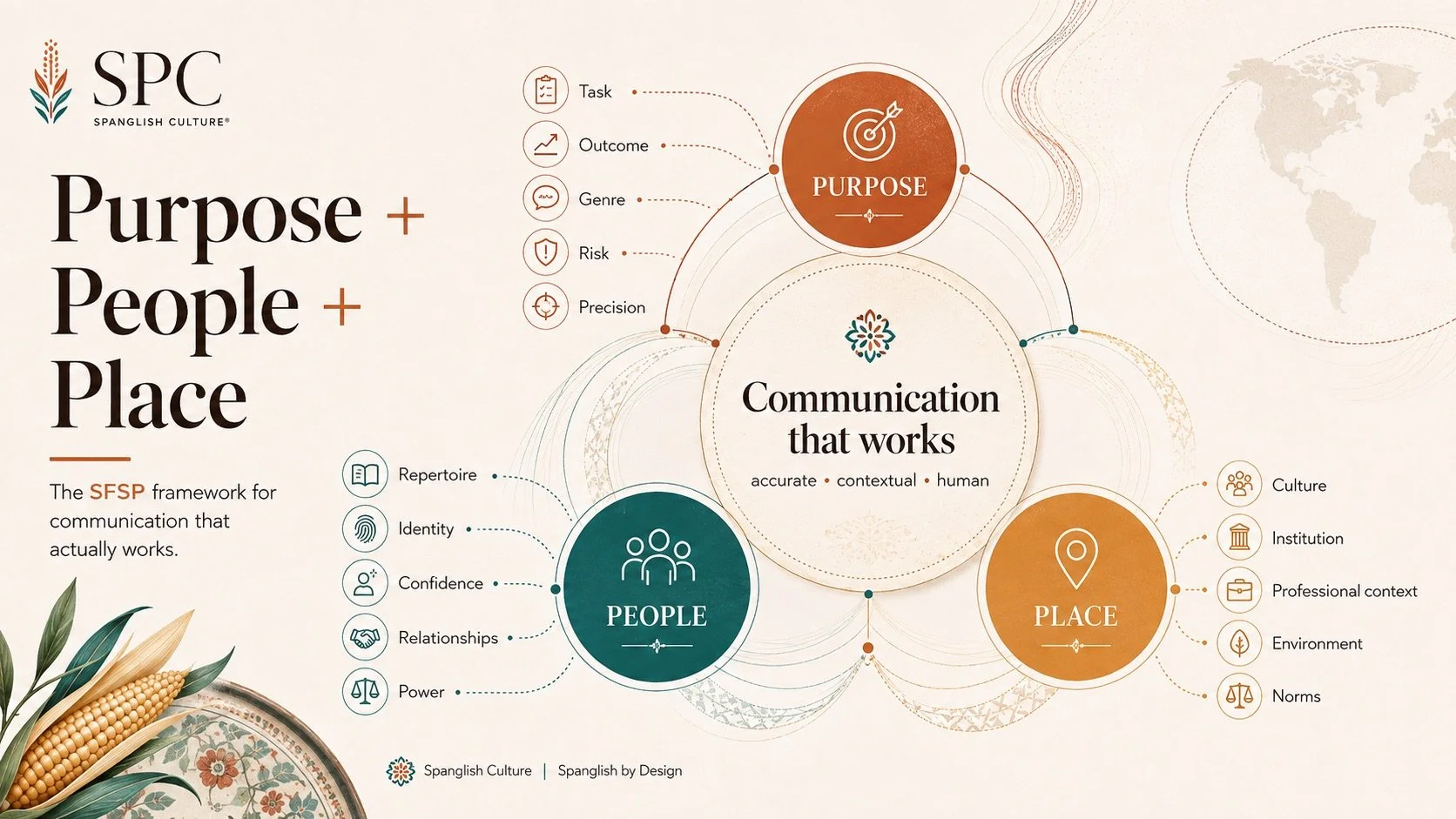
Purpose, People, and Place combining to create accurate, contextual, and human communication.
Why Spanglish belongs in the conversation
Translanguaging scholarship challenges the idea that bilingual people always operate through two fully separate language systems. It examines how multilingual speakers draw strategically on an integrated repertoire—including named languages and other meaning-making resources—to understand, express identity, solve problems, and communicate (Linville & Vinogradova, 2024).
Spanglish can be one visible expression of that repertoire. Sociolinguistic research documents it as a language-contact and sociocultural phenomenon shaped by community, identity, migration, power, and belonging (Pawliszko, 2020).
Esta distinción es lo que importa.
Not every grammar error is Spanglish. Not every English word inside a Spanish sentence is culturally meaningful. And not every setting should invite informal code-switching. Pero when bilingual speakers choose the resource that carries the clearest meaning, emotional accuracy, professional shorthand, or a cultural signal, eso es communicative design in real time.
SFSP makes that design teachable.
Spanglish in action: elegir, señalar, reparar
Spanglish in action no es Spanish garnish. Cada cambio has a job:
Elegir / Choose: use the language carrying the clearest term:
“Necesito the revised deck by three, pero primero flag the vendor risk.”
Señalar / Signal: switch when tone, identity, or relationship matters:
“Explícame your reasoning, no nomás the answer.”
Reparar / Repair: move across language, gesture, and repetition when meaning stalls: “¿Dónde le duele? Show me con un dedo. ¿Presión, ardor, or sharp pain?”
The goal is not to sound mixed. Es saber por qué cambias, what the switch carries, y cuándo regresar to formal Spanish or English.
Purpose + People + Place
The framework has three connected layers:
1. El propósito / Purpose: the task, outcome, genre, risk, and required precision.
2. La gente / People: the learner’s repertoire, identity, confidence, relationships, and power position.
3. El lugar / Place: the cultural, professional, institutional, and physical environment where meaning is negotiated.
Instead of “learn the imperative,” the target becomes: give a safe, respectful kitchen direction during a live production rush.
Instead of “practice travel vocabulary,” it becomes: ask whether a train is direct, understand the response, and repair the conversation when the answer comes too quickly.
Instead of “memorize body parts,” it becomes: describe where something hurts, compare sensations, and confirm what the clinician understood.
Grammar still matters, claro que sí. Pero, a la vez, también importa la precisión. Grammar is selected because the task needs it, not taught in isolation and hoped for later.
The pedagogy: learn through meaningful action
Current EFE research and multilingual pedagogy point toward a practical blend:
Start with needs, not assumptions.
Use interviews, observation, real artifacts, learner stories, and authentic samples.
“Spanish for work”
may actually mean giving feedback, handling a safety correction, calming a customer, or explaining a delay without sounding dismissive, frío, o sin empatía.
Teach tasks and genres.
Practice the forms communication takes: a handoff, briefing, intake, parent message, recipe, menu question, or travel-recovery conversation. Learners should notice how tone, vocabulary, structure, and cultural expectations change.
Use the full repertoire as a bridge.
Let learners brainstorm, annotate, rehearse, compare, and create across languages, then teach them to choose the right register for the audience and stakes. Translanguaging is not the absence of standards; it is a pathway toward intentional control.
Make learning multimodal and embodied.
Digital storytelling research shows how images, sound, voice, writing, collaboration, and personal “lifeworlds” can support active meaning-making (Linville & Vinogradova, 2024).
In a kitchen: see it, hear it, touch it, cook it, say it, remember it.
Assess whether communication works.
Correctness matters, especially in high-stakes settings, because it protects dignity, safety, and relationships. Assessment should also ask: Did the learner complete the task, repair confusion, and choose an appropriate register?
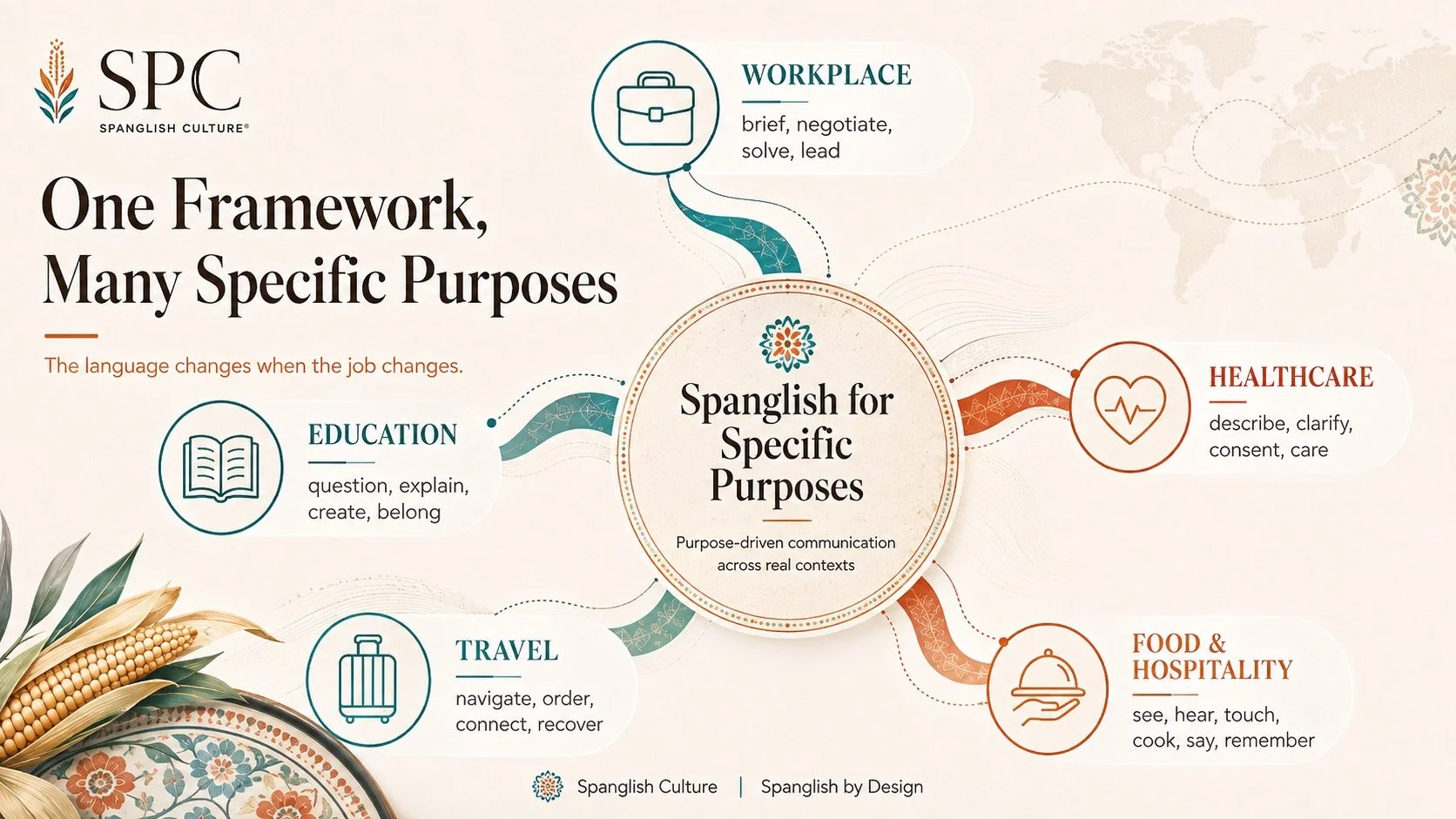
One SFSP framework applied across workplace, education, healthcare, travel, and food or hospitality.
One framework, many specific purposes
Workplace
“Necesito the revised deck by three, pero flag the vendor risk first.”
Inside a bilingual team that shares this repertoire—and where formal documentation and accessibility requirements are met—that may be faster and more precise than forcing every familiar technical term into one language. SFSP can teach learners to brief, negotiate, escalate, coach, document, and lead while also showing when formal Spanish or English is required.
Education
“Explícame tu reasoning—not just the answer.”
Some heritage learners may understand more than they comfortably produce, depending on exposure, schooling, community use, confidence, and the task. Family stories, community interviews, digital narratives, collaboration, and disciplinary content can help turn receptive knowledge into purposeful expression. The objective is not to erase home-language practices. It is to expand agency.
Healthcare
“¿Dónde le duele? Show me con un dedo. Is it pressure, burning, or sharp?”
Role-appropriate, assessed bilingual training can support rapport, clarification, symptom description, navigation, and patient education within demonstrated language proficiency. In high-stakes care, Spanglish practice must not substitute for qualified interpretation, approved terminology, or institutional protocols. The purpose is safer comprehension—not improvisation beyond competence.
Travel and leisure
“¿Este tren goes directo, o tengo que cambiar?”
Travel language becomes useful when it includes time pressure, accents, maps, menus, payment, politeness, and recovery: “Más despacio, por favor.” “Can you show me?” “¿Quiso decir…?” A traveler does not need to sound native. They need enough language and repair skill to keep moving and connect respectfully.
Food and hospitality
“Pon el comal on medium. Cuando la tortilla starts to puff, dale la vuelta.”
Food can be an especially useful learning environment because language attaches to visible action, sensory evidence, tools, timing, and shared cultural meaning (Stano & Bentley, 2022). The learner does not merely memorize “voltear.” They watch the tortilla change, hear the cue, perform the action, say it, and transfer the verb to another task.
Food is global culture—and a language laboratory
Food gives SFSP its clearest transcreational analogy.
Translation asks what a message means in another language.
Transcreation asks how a message may need to be adapted so it works for a particular audience and culture. Here, SFSP uses transcreation as an analogy and design resource—not as a substitute for precise translation when precision is required.
A recipe rarely travels word for word. “One cup,” “una taza,” “al tanteo,” “until it looks right,” and “como lo hacía mi mamá”. Those do not carry identical knowledge. A good culinary communicator translates the measurement, explains the sensory cue, protects the story, and adapts the method without stripping away identity.
Language works the same way. The goal is not a sterile sentence that survives translation but loses human emotional intelligence. The goal is a meaning that arrives intact.
A learning sequence built around maíz can move through five stages:
Encounter: see the ingredient in a market, kitchen, image, or story.
Decode: connect names, varieties, uses, histories, and sensory language.
Do: complete a real task—select, grind, mix, press, toast, serve.
Tell: explain the process through speech, writing, visuals, or digital story.
Transfer: reuse the language in a new setting: un restaurante, a classroom, workplace, clinic, or trip.
This is situated, multimodal, culturally responsive learning. It is designed to turn vocabulary into action and action into memory, while treating culture as dynamic meaning-making rather than a static list of facts (St. Clair, 2026).
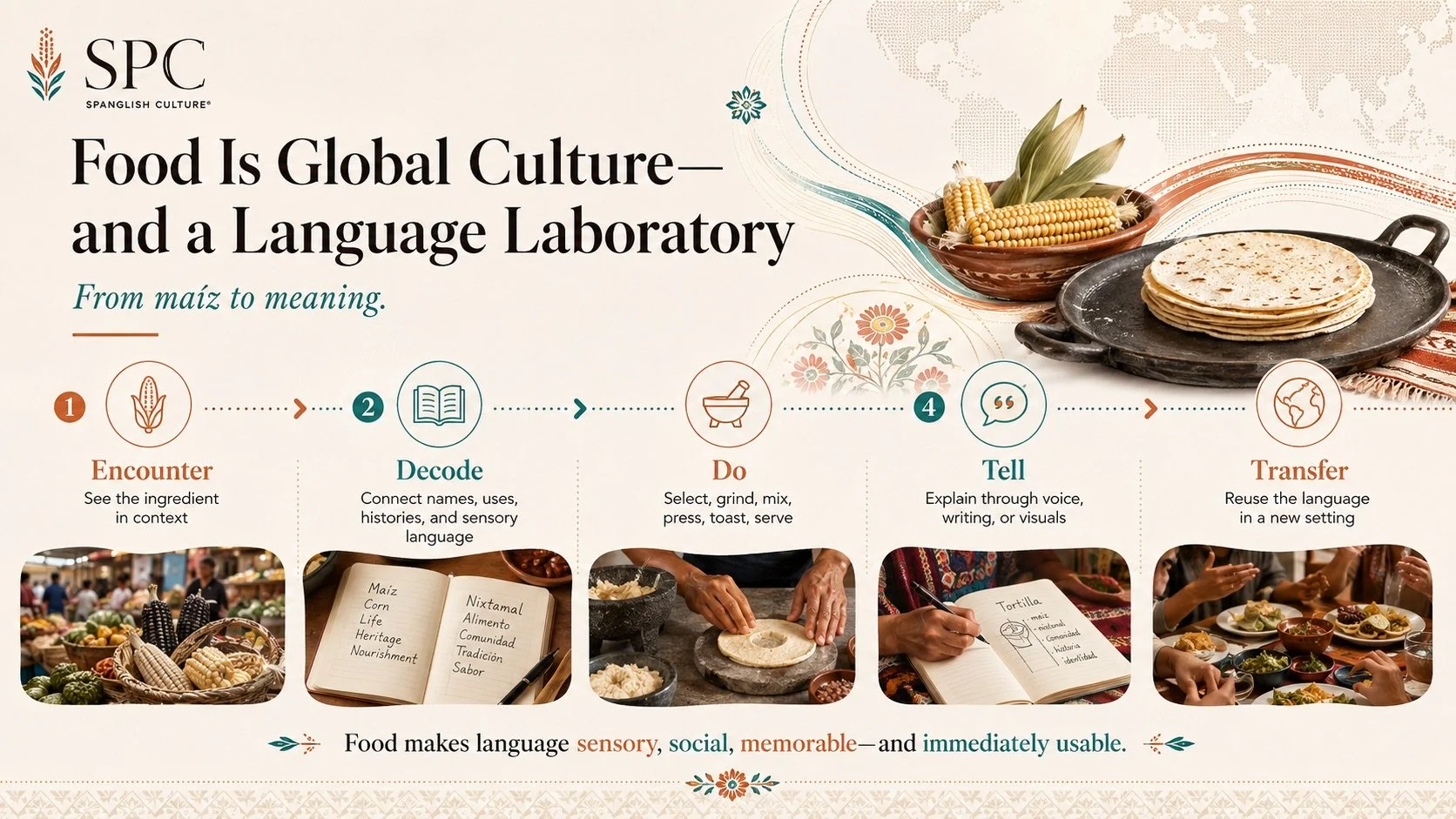
Five-stage food-language learning sequence: encounter, decode, do, tell, and transfer.
Beyond Spanish: communication designed for real life
The underlying idea does not stop with Spanish nor with language learning.
A family trying to preserve the stories no one wrote down has a specific purpose.
A traveler trying to recover a conversation after missing one important word has a specific purpose.
A manager translating strategy into something a frontline team can act on has a specific purpose.
So does a farmer explaining the value—and sabor—of imperfect-looking fruit to a customer accustomed to grocery-store uniformity. So does a healthcare worker building trust, an educator helping a student move from recognition to expression, or a corporate team communicating across roles, cultures, technical vocabularies, and cross-functional stakeholders.
Different people. Different places. Different stakes.
The same design question:
What must the meaning become so that it can be understood, remembered, trusted, and used?
That is the larger promise behind Spanglish for Specific Purposes.
Stop beginning with the words people are supposed to know.
Begin with the human being, the outcome, and the environment in which meaning has to survive.
Then choose the vocabulary. Adjust the register. Translate the technical language. Protect the cultural signal. Use the gesture, image, story, sensory cue, or familiar phrase that helps understanding click into place.
Sometimes that means formal Spanish.
Sometimes it means technical English.
Sometimes it means Spanglish, because for some bilingual communities it may be the most accurate map of how people in the room think, feel, work, and relate.
The objective is not mixture for mixture’s sake.
It is communication with enough precision to perform, and enough humanity to connect.
That principle applies in the home, across borders, inside organizations, and anywhere people must and want to build meaning together.
And, ultimately, that is how I approach the work:
I study the purpose. I listen for what people already carry. I examine the place where communication must function. Then I design the bridge between them.
Because the strongest communication does more than deliver information.
It helps meaning arrive intact.
Sources and intellectual grounding
Lafford, B. A., Ferreira Cabrera, A., & Arnó Macià, E. (Eds.). (2025). Español para Fines Específicos (EFE) / The Routledge Handbook of Spanish for Specific Purposes (SSP). Routledge.
Starfield, S., & Hafner, C. A. (Eds.). (2025). The Handbook of English for Specific Purposes (2nd ed.). Wiley Blackwell.
Linville, H. A., & Vinogradova, P. (2024). Digital Storytelling as Translanguaging: A Practical Guide for Language Educators. Routledge.
Pawliszko, J. (2020). Sociolinguistic Analysis of Mexican-American Bilingualism: Spanglish as a Sociocultural Phenomenon. Peter Lang.
Stano, S., & Bentley, A. (Eds.). (2022). Food for Thought: Nourishment, Culture, Meaning. Springer.
St. Clair, N. S. (2026). Teaching Culture in the 21st Century. Routledge.
Editorial note: “Spanglish for Specific Purposes” is an SPC-proposed applied framework. EFE/SSP is an established field; SFSP is SPC’s operational synthesis of that scholarship with translanguaging, bilingual identity, sociolinguistics, multimodality, cultural learning, and transcreation. SFSP is not presented as a validated curriculum model, and its effectiveness remains to be tested across tasks, learners, and settings.