How Manzanilla Became Ours
The plant came from somewhere else. The system that made room for it was already ours.
You could hear it before you got a cup. The kettle ticking, then the drawer, then that dry rustle of little dried flowers going into hot water. A sound like paper. Like something that had already lived once.
Then the cup in front of you, too hot to hold, and the instruction that was not really an instruction. Tómatelo. For your stomach. For your nerves. For the crying you were doing about something you would not explain. La manzanilla salía whenever somebody in that house looked like they needed to be sat with.
Here is the part nobody at the table knew, ni ella.
La flor no es de aquí
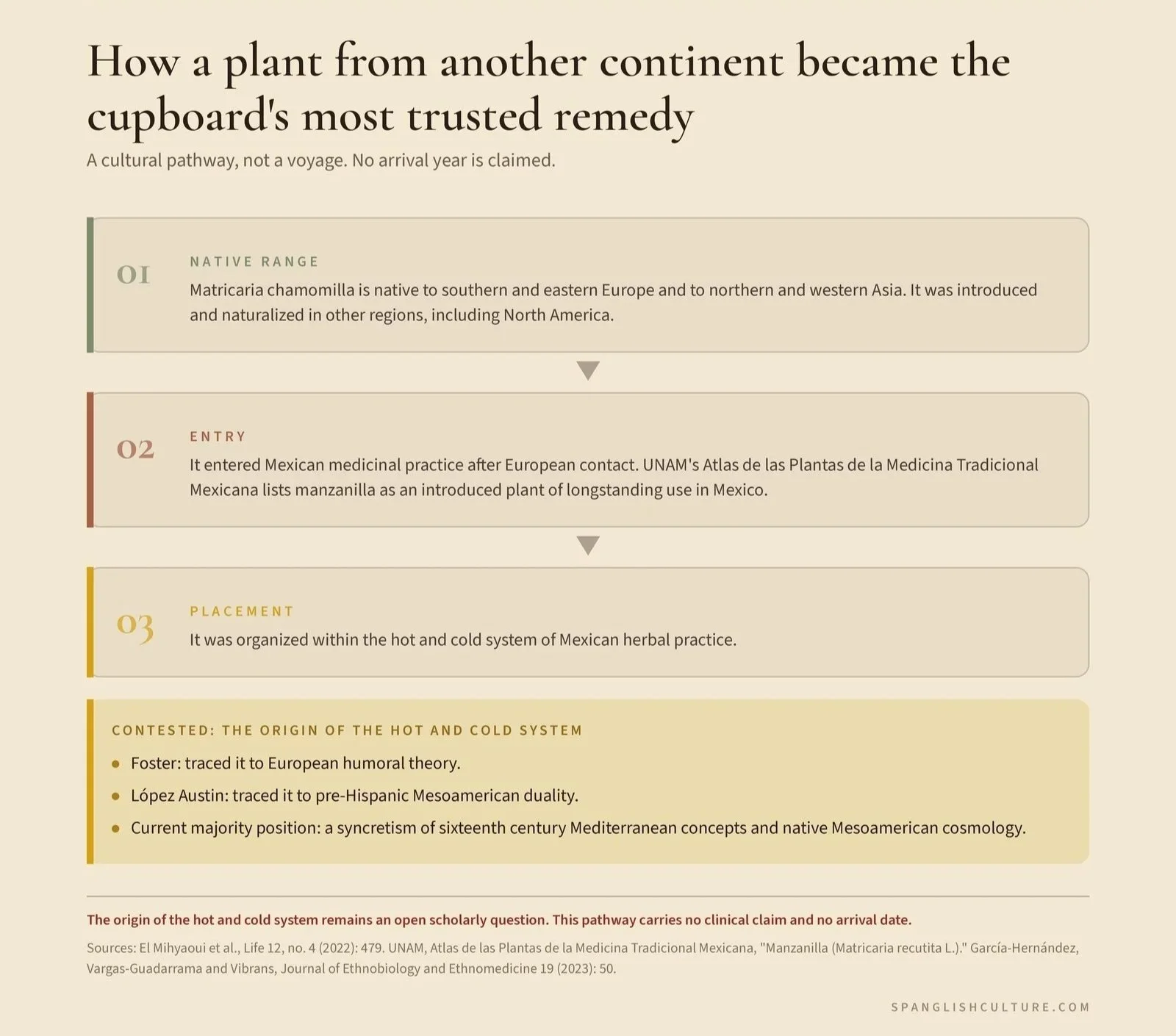
Chamomile is not from here. Matricaria chamomilla is native to southern and eastern Europe and to northern and western Asia. It was introduced and naturalized elsewhere, North America included. So the plant you set in your head beside maíz y cacao entered Mexican medicinal practice after contact. No antes.
Espérate, though. The reflex is to feel robbed, and the reflex is wrong.
What happened next is the interesting part, and it is messier than a European flower dropped into a finished Indigenous system. The hot and cold framework organizes a lot of Mexican herbal practice. It gives a plant a job by the condition it balances. Scholars have argued over where it came from for decades. George Foster traced it to European humoral theory. Alfredo López Austin traced it to the duality principle in pre-Hispanic Mesoamerican thought. Most researchers now treat the system as syncretic, sixteenth century Mediterranean concepts meeting a native Mesoamerican cosmology and becoming something neither one was alone.
That is not a footnote. Es la historia completa. Manzanilla did not get filed into a museum. It got taken into a living system that was already moving. Probada. Given a place. Passed down. Tu herencia no es la flor. It is the capacity to absorb something foreign y hacerlo útil sin pedirle permiso a nadie.
¿Y sí funciona?
So does it work?
Partly, modestly, and not the way your kitchen claims. One randomized trial enrolled fifty-seven outpatients with mild to moderate generalized anxiety disorder. It used a standardized chamomile extract, capsules standardized to 1.2 percent apigenin, on an escalating dose over eight weeks. The chamomile group showed a significantly greater reduction in anxiety scores than placebo. A 2024 systematic review of ten trials found most reported some anxiety benefit. But doses ran from 250 to 2,000 milligrams a day. Durations ran from two to twenty-six weeks. Populations were too different to pool, and the reviewers called for larger and better designed studies. The Merck Manual describes possible modest antianxiety activity, and notes that few studies have shown consistent clinical benefits. On sleep, the National Center for Complementary and Integrative Health says there is very little information, and that the one insomnia study it identified found no benefit.
Now read those doses again. Standardized capsules. On a schedule. In a study. Lo que está en tu taza is loose dried flowers steeped a few minutes in a mug. No es la misma exposición. Nobody has established a conversion between them. Anyone telling you your nightly tea is a clinical dose is telling you something the literature does not say.
Three cautions belong in the same breath as the affection. People allergic to ragweed, chrysanthemums, marigolds, or daisies are more likely to react to chamomile, and reactions can be serious. Chamomile may increase the effects of anticoagulants such as warfarin, and of sedatives. And on pregnancy the honest answer is not a prohibition. Es un hueco. Little is known about whether chamomile is safe during pregnancy or while breastfeeding. If you are pregnant, nursing, on blood thinners, or ragweed allergic, that is a conversation with a clinician. No una taza.
Lo que sí sobrevive
So what survives, once you know the plant came from somewhere else and the evidence is modest?
Everything that mattered. Whatever the flower gave you, the ritual was doing something else too. Somebody stopped. Boiled water. Y se sentó contigo while it cooled. That is not a measured therapeutic outcome and this article will not pretend it is one. It is just the part you actually remember.
And there is something exact about a household whose most trusted remedy is a plant that arrived through the same centuries of contact that disrupted the medicine already growing here. Se tomó de todos modos. Learned. Placed. Passed down as yours.
Lo que te llevas
Ni de aquí ni de allá. O sea, como tú.
Here is something you can do this week. Open your cupboard. Pick the one thing your family reaches for when nobody is really sick. Then call whoever handed it to you first. Ask two questions. ¿Quién te lo dio a ti? And what were you supposed to feel afterward. Write the answer on the box, where the dose would go. The dose you can always look up. Quién se sentaba contigo is the part that disappears.
La flor era prestada. Las manos que te la dieron no. Common sense. Nada fancy.
¿Y en tu casa? What did your family reach for when the problem was not really a stomach ache, y quién te lo preparaba?
Source notes
- El Mihyaoui, Amina, Joaquim C. G. Esteves da Silva, Saoulajan Charfi, María Emilia Candela Castillo, Ahmed Lamarti, and Marino B. Arnao. "Chamomile (Matricaria chamomilla L.): A Review of Ethnomedicinal Use, Phytochemistry and Pharmacological Uses." Life 12, no. 4 (2022): 479. Supports the native range in southern and eastern Europe and northern and western Asia, and introduction and naturalization elsewhere including North America. https://doi.org/10.3390/life12040479
- Universidad Nacional Autónoma de México, Atlas de las Plantas de la Medicina Tradicional Mexicana. "Manzanilla (Matricaria recutita L.)." Identifies manzanilla as an introduced plant of longstanding use in Mexico and documents its place in Mexican traditional medicine. https://www.medicinatradicionalmexicana.unam.mx/apmtm/termino.php?l=3\&t=matricaria-recutita
- García-Hernández, Karla Y., Luis Alberto Vargas-Guadarrama, and Heike Vibrans. "Academic history, domains and distribution of the hot-cold system in Mexico." Journal of Ethnobiology and Ethnomedicine 19 (2023): 50. Supports the Foster and López Austin positions and the current majority view that the system is syncretic. https://doi.org/10.1186/s13002-023-00624-1
- Amsterdam, Jay D., Yimei Li, Irene Soeller, Kenneth Rockwell, Jun J. Mao, and Justine Shults. "A randomized, double-blind, placebo-controlled trial of oral Matricaria recutita (chamomile) extract therapy for generalized anxiety disorder." Journal of Clinical Psychopharmacology 29, no. 4 (2009): 378 to 382. DOI: 10.1097/JCP.0b013e3181ac935c. Supports the fifty-seven outpatient sample, the 1.2 percent apigenin standardized extract, the escalating eight week dose, and the greater reduction in total HAM-A score versus placebo. https://pubmed.ncbi.nlm.nih.gov/19593179/
- "The Effect of Oral Chamomile on Anxiety: A Systematic Review of Clinical Trials." Clinical Nutrition Research 13, no. 2 (2024): 139. Supports the ten-trial scope, the 250 to 2,000 milligram daily dose range, the two to twenty-six week duration range, the heterogeneity limitation, and the call for larger and better designed research. https://doi.org/10.7762/cnr.2024.13.2.139
- Merck Manual Professional Edition. "Chamomile." Supports possible modest antianxiety activity, the note that few studies have demonstrated consistent clinical benefits, hypersensitivity including anaphylaxis in people allergic to Asteraceae plants, and the statement that chamomile may increase the effects of anticoagulants and sedatives. https://www.merckmanuals.com/professional/special-subjects/dietary-supplements/chamomile
- National Center for Complementary and Integrative Health, National Institutes of Health. "Chamomile." Supports the preliminary characterization of the anxiety evidence, the statement that there is very little information on insomnia and that one study found no benefit, the ragweed, chrysanthemum, marigold, and daisy allergy wording, the warfarin interaction report, and the statement that little is known about safety during pregnancy or breastfeeding. https://www.nccih.nih.gov/health/chamomile
