The Ancient Chemistry Inside a Corn Tortilla
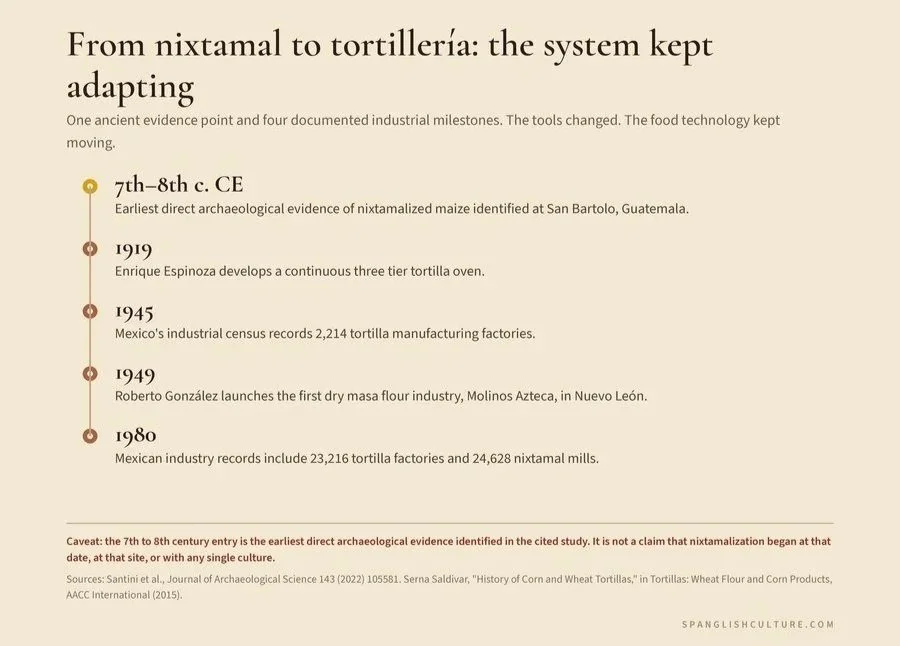
The tools changed. The food technology kept moving.
The comal is already hot before anyone in your house is awake. You know the sound: that dry slap of masa hitting iron, then the hiss, then the pause while everybody waits for the puff. When it rises, somebody makes a small noise of approval. Nobody explains why. You just learn that a tortilla que se infla salió bien.
Then the cloth. Always the cloth. A stack wrapped in a servilleta washed so many times the flowers are almost gone. Es que that cloth is doing real work. It holds the steam that keeps them soft while breakfast happens in shifts, porque nadie come a la misma hora.
Here is the part nobody told you at the table.
Your tortilla starts with chemistry.
La química que nadie te explicó
Nixtamalization cooks dried maize in an alkaline solution. Traditionally lime, or wood ash. The heat and the alkalinity soften the kernel and loosen the outer layer, so the grain grinds into masa. It also changes the nutrition. Bound forms of niacin become more available to the body. Calcium from lime can move into the grain. That mattered where maize became the foundation of a diet. Populations that leaned hard on untreated maize were vulnerable to pellagra, a serious niacin deficiency disease.
The mechanism is messier than the old story that lime unlocks a vitamin. Research shows nixtamalization can improve available niacin even while some total B vitamins are lost. Scientists still debate how shifts in amino acid balance add to the protection. The point is not that your ancestors secretly knew biochemistry. Es que generations of watching produced a technology that worked.
And it is ancient, aunque cuidado with that word. Archaeologists have direct evidence of nixtamalized maize from Maya contexts in Guatemala, seventh and eighth centuries CE. Researchers believe the practice runs deeper into pre Columbian time. Pero el registro no te deja name one inventor. One nation. One starting date.
That uncertainty does not make the achievement smaller. It makes your inheritance more honest.
Your story also refuses the corn versus flour purity test. Wheat arrived after European colonization. But flour tortillas were developed in Mexico and rooted deep in northern foodways. Una tortilla de harina de Sonora is not a watered down version of something realer. Es otra historia. Y punto.
Y luego, el trabajo
Then there is the labor.
For centuries this was women's work. Mechanization changed it. It did not erase it. Historical research on Mexico City and Guadalajara puts women at the center of production even as mills and factories took over the industry. Research in rural Mexico still documents women spending hours at it by hand, work tied to food, household income, fuel, health, and cultural continuity.
El sistema se hizo más grande
So the warm stack on your table holds two truths at once. Es memoria, y es trabajo. Cariño y obligación. Honoring it means refusing to erase either side.
Industrialization belongs in here too. Mexico's tortilla industry was mechanizing by the early twentieth century. A continuous three tier oven appeared in 1919. The 1945 industrial census counted 2,214 tortilla factories. Dry masa flour followed mid century, so masa could be made fast without running the full wet nixtamal process in every kitchen or tortillería.
El comal no desapareció. Your system just got bigger.
That is what survives the audit. Not a food frozen in time. A technology that kept adapting. Indigenous food science moved from ash and lime, to household masa, to the mill on your corner, to industrial production. Y la tortilla siguió cargando region, labor, memory, belonging.
Lo que te llevas
Your abuela was not being quaint. She knew by touch that the masa was ready. By sound that the comal was hot. By sight that the puff was coming.
So the next time yours comes out flat, resist calling it failure. Maybe your comal was cold. Maybe your masa needed one more minute. Tu mano todavía está aprendiendo, y eso no es defecto. It is the same apprenticeship every pair of hands before yours went through.
Here is one thing you can do this week. Make them once without a recipe, y fíjate en el sonido. Listen for the change when your pan is ready. Watch when the edge lifts. Then call whoever taught your family and ask one question: ¿cómo sabías que ya estaba? Write down exactly what they tell you, even if it makes no sense on paper. Especially then. Esa es la receta.
She was never being quaint. Estaba operando un sistema. Common sense. Nada fancy.
¿Y en tu casa? Who made the tortillas everybody quietly agreed were the best, y qué sabía that nobody ever wrote down?
Source notes
- Santini, Lauren M., et al. “First archaeological identification of nixtamalized maize, from two pit latrines at the ancient Maya site of San Bartolo, Guatemala.” Journal of Archaeological Science 143 (2022): 105581. https://doi.org/10.1016/j.jas.2022.105581
- Hrubša, Michal, et al. “Biological Properties of Vitamins of the B Complex, Part 1: Vitamins B1, B2, B3, and B5.” Nutrients 14, no. 3 (2022). Niacin bioavailability, nixtamalization, and pellagra discussion. https://pmc.ncbi.nlm.nih.gov/articles/PMC8839250/
- Garcia Casal, Maria Nieves, et al. “Fortification of maize flour with iron for controlling anaemia and iron deficiency in populations.” Cochrane Database systematic review. Includes nutritional effects of nixtamalization, including bioavailable niacin and calcium, while noting remaining amino acid limitations. https://pmc.ncbi.nlm.nih.gov/articles/PMC6517107/
- Serna Saldivar, Sergio O. “History of Corn and Wheat Tortillas.” In Tortillas: Wheat Flour and Corn Products. AACC International, 2015. https://doi.org/10.1016/B978-1-891127-88-5.50001-3
- Gómez Galvarriato, Aurora. “Female entrepreneurship as a survival strategy: women during the early mechanisation of corn tortilla production in Mexico City.” Continuity and Change 35, no. 1 (2020): 75 to 103. https://doi.org/10.1017/S0268416020000065
- Fernández Aceves, María Teresa. “Once We Were Corn Grinders: Women and Labor in the Tortilla Industry of Guadalajara, 1920 to 1940.” International Labor and Working Class History 63 (2003): 81 to 101. https://doi.org/10.1017/S0147547903000103
- “Reframing native maize conservation, the energy gender nexus, and food sovereignty in rural Mexico.” Elementa: Science of the Anthropocene, 2026. https://online.ucpress.edu/elementa/article/14/1/00023/217319/Reframing-native-maize-conservation-the-energy
