Clean Had a Smell
The scent is the same. The job is not.
Saturday, seven-something in the morning. Every window in your house is already open. The radio is too loud for the hour. Y toda la casa smells like purple.
Not lavender exactly. Purple. That specific sweetness coming off a bucket of mop water, getting into the couch, into your hair, into the memory of every Saturday that came after. You can be forty years old in another state, smell it in a stairwell, y de golpe te acuerdas. Somebody in that building got up early, y no pensaba dejar que la juzgaran.
Espérate, though. Before this turns into a nostalgia post.
That bottle is not an inheritance. Es un producto. U.S. trademark records list Fabuloso in commerce at least as early as March 26, 1982, and the mark was federally registered in 1986. Whatever it means in your house, llegó dentro de una vida. No es una línea ancestral.
So here is your question. ¿El olor de verdad quería decir limpio?
Limpio y desinfectado no son la misma cosa
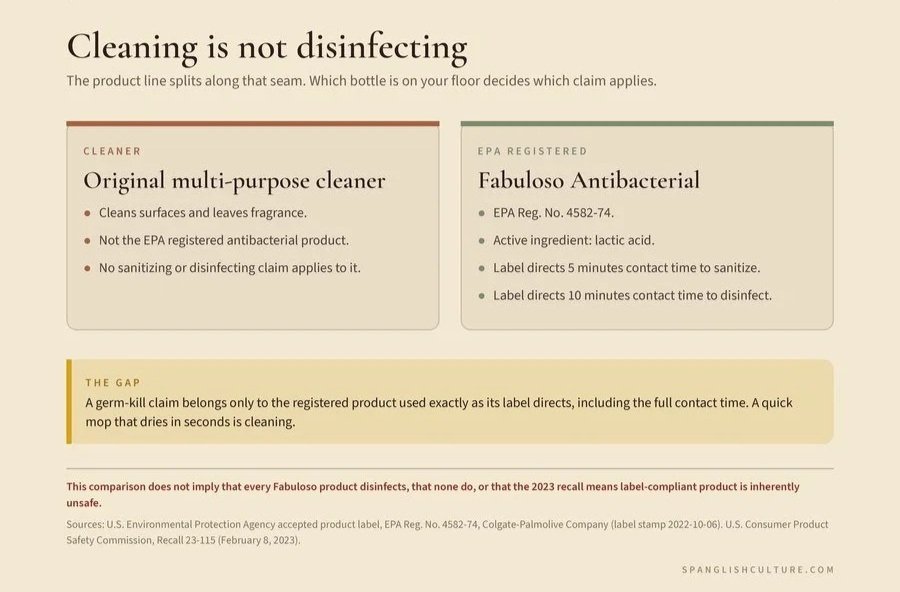
Cleaning and disinfecting are two different jobs, and the product line splits along exactly that seam. The familiar Original multi-purpose cleaner is not the same product as Fabuloso Antibacterial. The antibacterial version is registered with the Environmental Protection Agency, EPA Reg. No. 4582-74, with lactic acid as its active ingredient. Its label carries sanitizing and disinfecting directions, plus the part almost nobody follows: a required contact time. Five minutes to sanitize. Ten to disinfect. Any germ-kill claim belongs to that specific registered product, used exactly that way.
Now think about what you actually watched happen. Cleaner down. Mop across your floor. Se seca solo. Nada más.
That gap is where your real story lives. En muchas casas the scent was not doing microbiology. Estaba dando testimonio. Where your work is invisible all week, a smell that lasts until Tuesday is evidence. It says: yo hice esto, míralo, huele. That is a reading, not a measured fact about anybody's población. But it is the reading your memory keeps handing back.
La parte que la memoria no guarda
Then there is the part your memory does not keep.
In February 2023 the Consumer Product Safety Commission pulled about 4.9 million units of Fabuloso off shelves in the United States, plus roughly 56,000 in Canada. The products could contain Pseudomonas aeruginosa and Pseudomonas fluorescens, environmental organisms found widely in soil and water. The agency flagged serious infection risk for people with weakened immune systems, external medical devices, or lung conditions, and noted that people with healthy immune systems are typically unaffected. That was a problem with specific lots. It was not a verdict on the formula used as labeled. Say it that precisely, or do not say it.
And the bottle itself has a longer paper trail. Between January and April of 2006 the Texas Poison Center Network logged 112 Fabuloso calls, including 104 human exposures, of which 94 were unintentional ingestions. Most involved children under six. The case series also included adults over twenty. Researchers who study what they call food imitating products argue that packaging borrowing the color, the clarity and the imagery of a drink can generate food-related associations in the people handling it. Eso es un argumento sobre el diseño. It is not a claim that the bottle takes away your judgment.
Two lines come straight from the brand's own current guidance. No lo calientes. Y no lo mezcles con cloro. Those are label boundaries, not household hacks to improvise around.
Y ahora la revisión de nosotros mismos
There is a version of this piece that turns into a joke about immigrant houses smelling like chemicals. Ese chiste is classism with a punchline. Aquí no.
Fabuloso is not culturally exclusive, and different families carry different scent markers of clean. Maybe you recognize the fragrance as home. Maybe it gives you a headache, y también está bien. Neither answer defines your culture, and neither one owes anybody an explanation. Class judgment about strong fragrance turns your house's preference into a stereotype, y eso es exactamente the flattening this series exists to refuse.
Lo que sí sobrevive
So what survives the audit?
Not the belief that the scent sterilized your floor. What survives is the standard behind it. La negación a dejar que a rented apartment, a night shift, or a tight month be read as neglect. Somebody decided how your house was going to be seen, y lo defendió con los dos dólares que había. That is not naive. Es estrategia.
Keep that. Read the label for the rest. Common sense. Nada fancy.
Lo que te llevas
Here is something you can do this week, and it costs nothing.
Go look at what is under your own sink. Read one label all the way through, including the contact time. Then call whoever taught you to clean. Ask what they used before yours, y por qué, and who taught them. Ask what their house smelled like when they were the kid. Write down what they say, next to the product name. Ingredient lists you can rebuild later. La razón por la que lo usaban is the part that disappears.
The smell was never proof that your house was clean. Era la prueba de que alguien se negó a que le dijeran sucia.
¿Y en tu casa? What is the smell that means somebody cleaned, and who were they saying it to?
Source notes
- U.S. Consumer Product Safety Commission. "Colgate-Palmolive Recalls Fabuloso Multi-Purpose Cleaners Due to Risk of Exposure to Bacteria." Recall 23-115, February 8, 2023. Supports the recall date, approximately 4.9 million U.S. units and 56,000 Canadian units, the Pseudomonas aeruginosa and Pseudomonas fluorescens identification, and the at-risk populations. https://www.cpsc.gov/Recalls/2023/Colgate-Palmolive-Recalls-Fabuloso-Multi-Purpose-Cleaners-Due-to-Risk-of-Exposure-to-Bacteria
- U.S. Environmental Protection Agency. Accepted product label, "Sparkling Citrus Fabuloso Complete Antibacterial Multi-Purpose Cleaner," EPA Reg. No. 4582-74, Colgate-Palmolive Company. Supports the registered antibacterial product, the lactic acid active ingredient, and the sanitizing and disinfecting contact times. https://www3.epa.gov/pesticides/chem_search/ppls/004582-00074-20221006.pdf
- Texas Poison Center Network case series on Fabuloso exposures, January 1 to April 20, 2006, presented at the American College of Emergency Physicians Scientific Assembly, October 2006, and published as a research letter: "Fabuloso: A Cleaning Product That Tastes and Smells Good Enough to Drink," Pediatrics 118, no. 2 (2006): 848. Supports 112 calls, 104 human exposures, and 94 unintentional ingestions, with the age distribution. https://publications.aap.org/pediatrics/article/118/2/848/68951/
- Basso, Frédéric, et al. "Why People Drink Shampoo? Food Imitating Products Are Fooling Brains and Endangering Consumers for Marketing Purposes." PLOS ONE 9, no. 9 (2014): e100368. Supports the food-imitating-product concept and the food-related association argument. https://doi.org/10.1371/journal.pone.0100368
- Fabuloso. "Frequently Asked Questions." Supports current brand guidance that Fabuloso products should not be heated and should not be used with chlorine bleach. https://www.fabuloso.com/en-us/faq
- United States Patent and Trademark Office, Trademark Trial and Appeal Board records for FABULOSO, Reg. No. 1412859. Colgate-Palmolive states first use in commerce at least as early as March 26, 1982; federal registration issued October 14, 1986. https://ttabvue.uspto.gov/ttabvue/ttabvue-91305106-OPP-1.pdf
